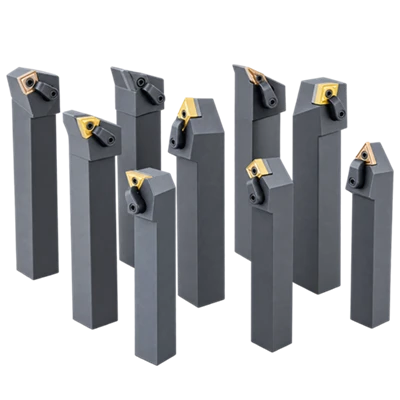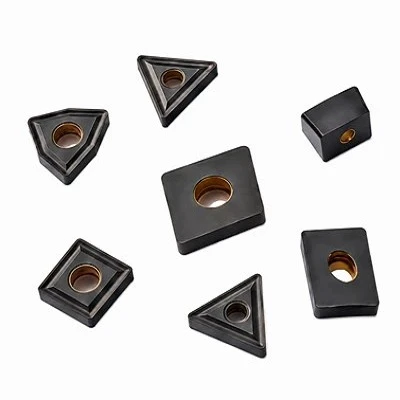

SW Negative E Series inserts are available in two principal geometries: EL and EM.

Types of L Series Inserts
Each type of E Series insert is tailored to different machining operations, from finishing to rough cutting. The following table highlights the features and applications of each insert geometry.

These inserts are especially popular in industries such as aerospace, defense, and energy, where precision and reliability are critical.
EL Inserts: Perfect for Light Cutting of Superalloys
EL inserts are primarily designed for finishing and semi-finishing operations. Their low cutting force design makes them suitable for processing long overhanging workpieces and thin-walled components. These inserts offer a sharp cutting edge that minimizes vibration and reduces the risk of tool damage. The EL inserts' geometry ensures stable chip control and smooth surface finishes, which is crucial when working with difficult-to-machine materials like titanium alloys and high-temperature superalloys.
As noted by Wang & Li (2019)[2], low cutting forces are essential for maintaining dimensional accuracy and avoiding vibration when machining delicate or complex geometries. The EL series inserts' unique design significantly reduces these challenges, offering a precise cutting action that improves machining quality.
EM Inserts: High Cutting Strength for Deep Machining
For more demanding operations such as semi-finishing and roughing, the EM inserts are the go-to solution. They feature a high cutting edge strength, which is ideal for deep cuts in high-temperature alloys. The EM inserts provide a balance between strength and sharpness, ensuring efficient chip removal even under high cutting forces. Their ability to perform under high thermal loads and aggressive cutting conditions makes them indispensable for applications like superalloy machining.
In a study by Guo & Liu (2020)[3], it was found that EM inserts excel in machining high-temperature materials like GH4169 (a nickel-based superalloy), as they maintain a stable cutting edge and resist wear effectively in harsh machining environments.
processing scope
Geometry EL is suitable for light cutting of superalloy.
Geometry EL is suitable for medium cutting of superalloy.
Turning inserts for difficult-to-machine materials
Case Study: Machining GH4169 Using EM Inserts
A practical example of the EM insert's performance can be seen in the machining of GH4169, a high-temperature superalloy. For this task, the CNMG120408-EM insert (Grade GST7115) was used under the following conditions:
|
Insert |
CNMG120408-EM |
|
Grade |
GST7115 |
|
Material |
GH4169(HB350-400) |
|
Speed |
Vc=30m/min |
|
Feed |
fr =0.15mm/r |
|
Depth |
ap=1mm |
|
Cooling |
Water base emulsion |
|
Machining type |
Continuous semi-finish turning of external cylinders |
Machining Type: Continuous semi-finish turning of external cylinders
This case demonstrates how EM inserts perform effectively in deep cutting operations, maintaining excellent surface quality and tool life even under aggressive cutting conditions.
Application
The SW Negative E Series is intended for turning difficult-to-machine materials, particularly nickel-based superalloys, other high-temperature alloys and titanium alloys. Typical users include manufacturers in aerospace, energy and precision engineering, where component integrity, dimensional consistency and process reliability are important.
EL is the recommended geometry to evaluate for light cutting and finishing operations. EM is the geometry to evaluate when semi-finishing or roughing requires a stronger cutting edge.
Application Case: Machining GH4169 with EM Inserts
A reference application on the original product page describes continuous semi-finishing of an external cylinder made from GH4169 nickel-based superalloy. The insert used was CNMG120408-EM in grade GST7115. The published conditions are reproduced below as a starting reference, not as guaranteed settings for every machine or component.
|
Insert |
CNMG120408-EM |
|
Grade |
GST7115 |
|
Workpiece material |
GH4169 (HB350–400) |
|
Cutting speed |
Vc = 30 m/min |
|
Feed rate |
f = 0.15 mm/rev |
|
Depth of cut |
ap = 1 mm |
|
Cooling |
Water-based emulsion |
|
Machining operation |
Continuous semi-finishing of external cylinders |
Performance in production will vary with machine rigidity, tool overhang, workpiece condition, coolant delivery and the stability of the setup. Validate the cutting data through a controlled trial and inspect wear, chip formation, surface finish and dimensional results.
How to Choose the Right E Series Insert
Selection should be based on the workpiece alloy, machining stage, required surface quality and rigidity of the machine-tool-workpiece system.
Choose EL for finishing and semi-finishing when low cutting forces and dimensional control are priorities, especially on long-overhang or thin-walled components.
Evaluate EM for semi-finishing and roughing when the operation requires greater edge strength or a deeper cut.
Select among GST7115, GST7120 and GST7130 according to the material and cutting conditions, then confirm the choice in a sample test.
Maintain a rigid setup, minimize tool overhang, ensure suitable coolant delivery and monitor flank wear, chipping and surface finish.
Frequently Asked Questions
EL geometry is designed for low cutting forces, making it suitable for finishing and semi-finishing, particularly on long-overhang and thin-walled workpieces.
The series is primarily positioned for superalloys and high-temperature alloys. It can also be evaluated for titanium alloys and other difficult-to-machine materials after application testing.
Use cutting parameters appropriate to the workpiece material and operation, maintain stable clamping, and provide effective coolant such as water-based emulsion where suitable. Monitor wear and adjust parameters based on actual results.
EL inserts are intended for finishing and semi-finishing where low cutting forces, process stability and surface quality are important.
Conclusion
The SW Negative E Series provides EL and EM geometry options for machining superalloys, high-temperature alloys and titanium alloys. EL focuses on low-force finishing and semi-finishing, while EM offers a stronger cutting edge for more demanding operations. With GST7115, GST7120 and GST7130 PVD-coated grade options, users can evaluate a suitable combination for their material and machining conditions. Contact SW with your workpiece material, insert code and cutting parameters to discuss a suitable trial solution.
Hot Tags: Carbide Turning Inserts, China Carbide Turning Inserts manufacturers, suppliers, factory, api threading inserts, carbide inserts for internal threading, Indexable Milling Insert, iso metric threading inserts, multi edge threading inserts, un carbide threading inserts