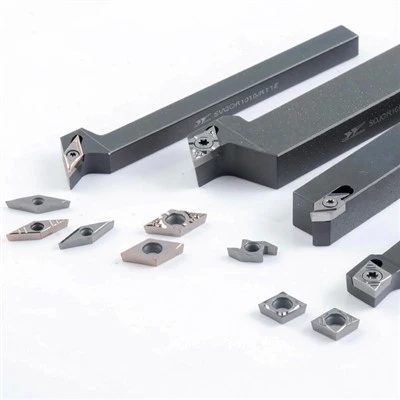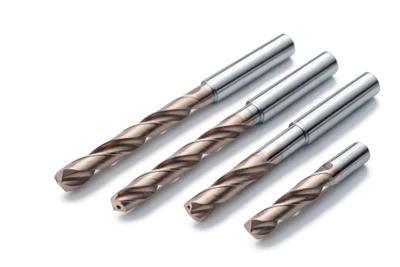
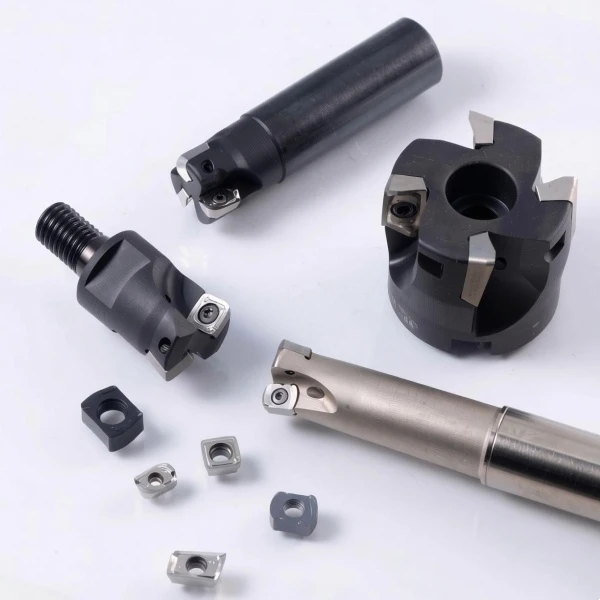
- For face milling & shoulder milling
- For slotting and pocket milling
- For copy milling and profile milling
- For high speed milling of steel, stainless steel, cast irong.
Product Features
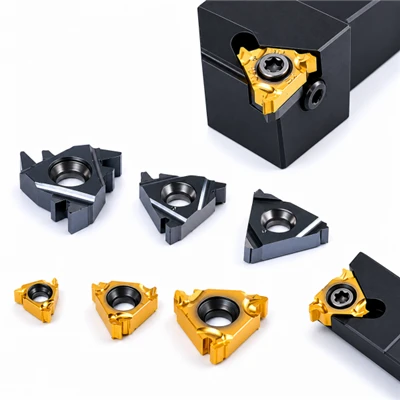
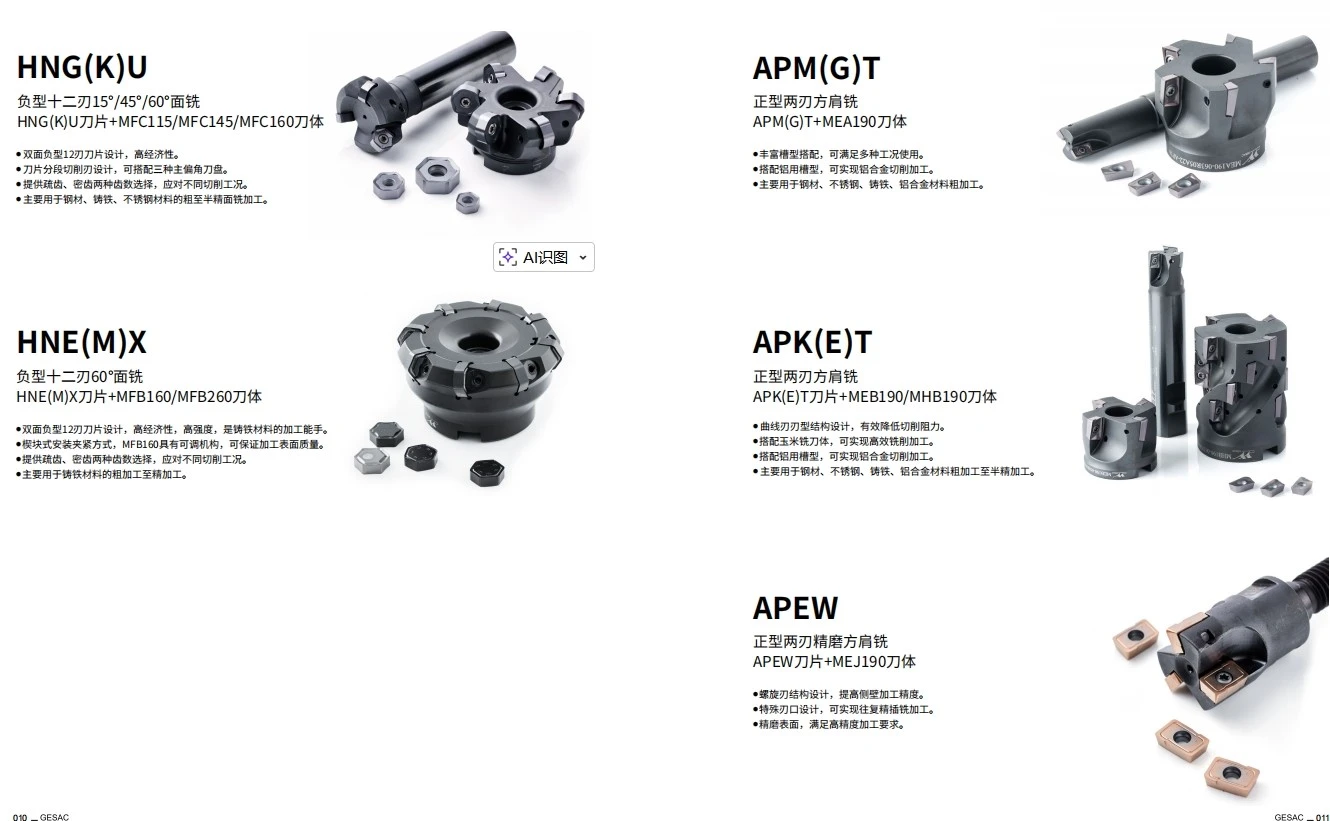
Multi-edge Design
Each insert typically features 2 to 8 independent cutting edges (e.g., square inserts have 4 edges, octagonal inserts have 8 edges). When one edge becomes worn, the insert can simply be indexed to utilize a fresh edge, eliminating the need for regrinding.
01
Precision Pressing/Grinding
Utilizing high-precision powder metallurgy molding or peripheral grinding processes, the insert achieves dimensional tolerances within the ISO P10–P15 range, ensuring a cutting height and profile repeatability of ≤0.025 mm after indexing.
02
Comprehensive Coating Systems
PVD (TiAlN/AlCrN) offers resistance to thermal cracking, making it suitable for stainless steel and titanium alloys; CVD (TiCN+Al₂O₃) provides high wear resistance and is designed for high-speed milling of steel and cast iron components; select inserts feature post-treatments (such as smoothed edges) to suppress built-up edge formation.
03
Diverse Chipbreaker Geometries and Edge Preparations
Sharp edges (without edge rounding) are designed for aluminum alloys; T-type reinforced edges are utilized for roughing operations; and designs incorporating wiper edges serve to enhance surface finish quality.
04
Material Selection
Carbide (the mainstream choice); Cermet (delivering superior surface finish in finishing operations); and CBN/PCD, specifically tailored for machining hardened steels and non-ferrous metals.
05
Advantages Compared to Similar Products
Comparison Objects: Solid Carbide Milling Cutters vs. Welded Milling Cutters
|
Comparison Dimensions |
Indexable Milling Inserts |
Solid vs. Welded Milling Cutters |
|
Cost Efficiency |
When an insert becomes dull, only the insert itself needs to be replaced; the cutter body remains usable for an extended period, reducing the cost per cutting edge by 50% to 80%. |
When a solid milling cutter becomes worn, the entire tool must be scrapped; welded tools, conversely, require return to the factory for regrinding-a process that entails significant machine downtime. |
|
Tool Change Time |
Indexing or replacing an insert can be completed within 1 to 2 minutes, requiring no subsequent tool adjustment. |
Regrinding involves disassembly, shipment for repair, and tool setting-a time-consuming process that can take several hours. |
|
Cutting Performance |
Specific coatings and chipbreaker geometries are selected to suit various workpiece materials (e.g., AlCrN coatings with negative rake angle geometries for high-temperature alloys). |
Solid tools typically feature a single type of coating, making it difficult to achieve optimal performance across a diverse range of materials. |
|
Machining Range |
The inserts cover a wide range of machining operations-including rough milling, finish milling, ramp milling, and plunge milling-simply by swapping the insert. |
With solid tools, a specific cutting geometry is typically dedicated to a single, specific application. |
|
Environmental & Maintenance Aspects |
No coolant is required for grinding, and there is no dust generated from grinding wheels. |
Regrinding generates waste material, and repeated regrinding ultimately leads to a degradation in the quality of the cutting edge. |
Hot Tags: indexable milling insert, China indexable milling insert manufacturers, suppliers, factory