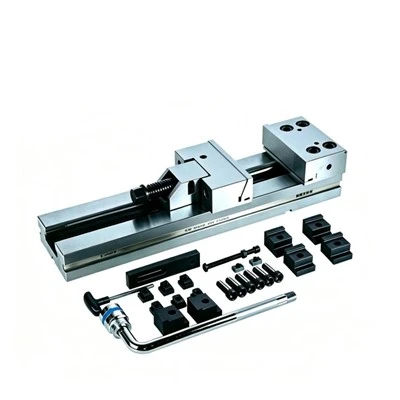
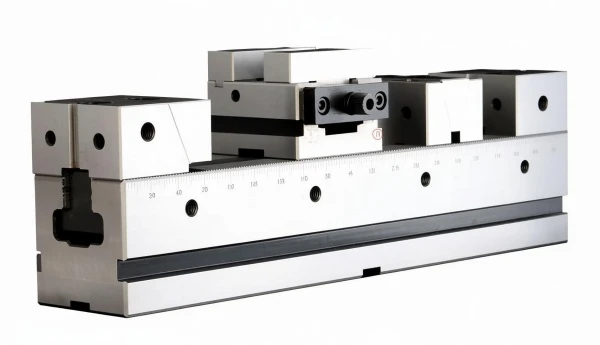
- Multi-station integrated design enables simultaneous clamping of multiple work-pieces, greatly improving batch processing efficiency.
- High rigidity casting body, stable structure, strong anti-deformation ability, suitable for heavy cutting operations.
- Suitable for CNC machining centers, milling machines, drilling machines.
Product Benefits
Multi-station vises integrate two or more independent clamping positions onto a single base, thereby significantly enhancing machining efficiency and precision.
First, efficiency is multiplied, and production capacity is substantially increased.
A single setup allows for the simultaneous clamping of multiple workpieces (typically 3 to 6 stations), enabling the production of multiple finished parts within a single machining cycle. Consequently, the time required for clamping and alignment is distributed across multiple parts, rendering auxiliary time virtually negligible.
Second, consistency is superior, resulting in higher machining precision.
Since all parts are machined simultaneously-under identical environmental conditions and with uniform clamping force-positioning errors caused by multiple individual setups are completely eliminated. This makes the system particularly well-suited for part assemblies requiring precise fits or complete interchangeability.
Third, it offers high space utilization efficiency.
The integrated downward clamping force ensures more precise workpiece positioning and enhanced safety; furthermore, installing a single multi-station vise within the limited space of a machine tool table is more space-efficient and results in a more compact layout compared to installing multiple single-station vises.
Fourth, it is compatible with automation and reduces unit costs.
Robots can simultaneously load multiple raw workpieces or unload finished parts in a single operation, integrating seamlessly with automated systems to enable efficient, unmanned production. Although the initial investment may be higher, the subsequent increase in production capacity significantly reduces the per-part allocation of costs-such as machine depreciation and labor-resulting in a substantial reduction in overall unit costs.
Manufacturing Process
The production of multi-station vises involves several stages, including material selection, precision machining, heat treatment, and surface treatment.
The vise body is typically forged from high-strength ductile iron (such as 80,000 PSI grade) or alloy steel to ensure sufficient rigidity and resistance to deformation. High-quality products utilize solid bars of high-tensile-strength Dura-Bar cast iron, which undergo precision machining to eliminate the rough, sand-cast surface texture characteristic of traditional castings. The lead screw is typically crafted from high-tensile alloy steel that has undergone a quenching process, with its threads precision-ground to micron-level tolerances; the vise jaws are similarly constructed from alloy steel and subjected to surface hardening treatments.
Following preliminary forging, the raw blanks undergo precision milling and grinding to ensure the flatness and parallelism of all assembly surfaces. Critical transmission components-such as the interface between the lead screw and the nut-are held to micron-level tolerances to guarantee smooth manual or pneumatic operation and consistent clamping force.
The guide rails of the vise body and key load-bearing areas typically undergo flame hardening or induction hardening to enhance wear resistance. These processes are complemented by surface treatments-such as electroplating, anodizing, painting, or powder coating-to effectively prevent rust and enhance the overall aesthetic appeal of the unit. The transmission screw is treated with nickel plating or nitriding to bolster its corrosion resistance and wear resistance.
Hot Tags: multi station vise, China multi station vise manufacturers, suppliers, factory, machine tool accessories, Multi Station Vise, Precision CNC Milling Machine Vise, VSD Series Precision Vise